spoke : Characterized Wheel Failure
Junior Design Lab II at UPenn
Spring 2015
Student teams were tasked with designing and building one subsystem of a machine designed to perform at a nominal condition but fail at 2.5x that condition. We decided to build a fan-powered car, and my team was in charge of the chassis subsystem. Inspired by innovative concepts for in-wheel suspension such as the LoopWheel and the SoftWheel, we decided to investigate the failure of wheels with curved spokes.

CHASSIS SUBASSEMBLY RENDER

ASSEMBLED CHASSIS
I used parametric modeling in SolidWorks to streamline the generation of different designs and then a combination of COMSOL FEA and static testing on the MTS machine to characterize the effect of three features of the spokes on the failure of the wheel: number of spokes, spoke thickness, and spoke radius of curvature. The FEA allowed us to determine the worst-case load angle for the wheel, and subsequent MTS tests were performed at that angle.

PARAMETERIZED WHEEL MODEL

FEA TO DETERMINE WEAKEST LOAD ANGLE

STATIC TESTING ON MTS MACHINE
The results of the static load testing supported our understanding that thicker spokes would be stronger and withstand higher forces but surprised us by showing that increased curvature of the spoke did not correspond to weaker wheels. We observed that straighter spokes tended to fail in tension, while curvier spokes tended to fail in compression. Interestingly, these different failure modes were not visible in the data.

FORCE VS. DISPLACEMENT FOR CHANGING SPOKE THICKNESS

FORCE VS. DISPLACEMENT FOR CHANGING SPOKE CURVATURE
While the MTS testing was interesting (and fun), it was not particularly helpful to characterizing the impact failure of the wheels. We decided to turn our focus to dynamic failure of the nominal wheel design, and rigged up a pulley to let us to consistently accelerate the chassis by dropping a known mass down the stairwell. We were able to experimentally determine the impact speed at which the wheels first showed signs of cracking, and thus the nominal and failure run-up distances for the fan car based on the thrust measured by the propulsion subsystem team.

NOMINAL DISTANCE COLLISION (NO FAILURE)

2.5X NOMINAL DISTANCE COLLISION (FAILURE)
Our subsystem failed as we had intended during the final demonstration. At our nominal run-up distance of 4.5m our wheels showed no signs of damage. At our failure run-up distance of 11.25m, the front wheels were completely destroyed as all four spokes broke on impact. High speed video (120fps) of the crash shows how the front spokes failed first in compression, followed by the back spokes failing in tension.
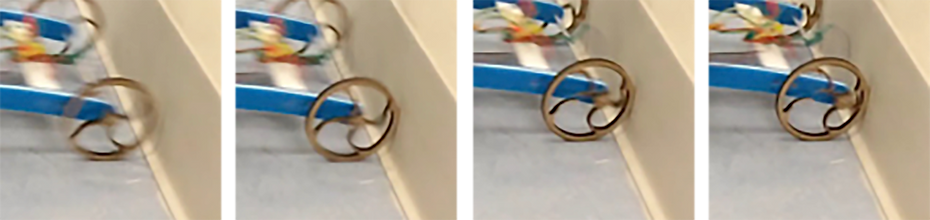
FRAME-BY-FRAME OF 2.5X NOMINAL DISTANCE COLLISION FAILURE